
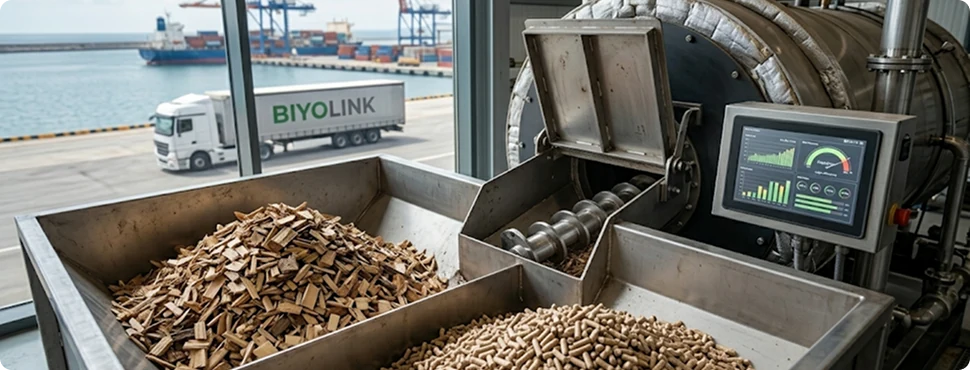
As fuel costs and carbon obligations rise, industrial plants are turning from coal, fuel oil and petcoke to biomass. The two fuels chosen most often in that switch are pellets and wood chips. Both can be produced from domestic sources, both run on automatic feeding systems, and in the right boiler both are nearly as easy to operate as fossil fuel. So what are their real advantages for industrial boilers?
1. Standard size, trouble-free feeding
Pellets are made by compressing sawdust and wood residues under high pressure, so their diameter and length are standard. They flow smoothly from the silo to the boiler by screw conveyor, the feed system does not jam and combustion settings stay stable for long periods. Wood chips screened to a size class can likewise be fed automatically with walking floors and screws. The international ISO 17225 series defines size, moisture and ash classes for both fuels.
2. Low moisture, high and predictable calorific value
Moisture affects boiler efficiency more than any other value: the water in the fuel consumes energy as it evaporates. Because pellets are dried during production, their moisture is usually below 10 percent and their calorific value is around 4,000–4,500 kcal/kg. The moisture of wood chips depends on the source and how long they have been stored; dried chips deliver roughly 2,500–3,500 kcal/kg depending on moisture. Knowing these values for every lot from laboratory analysis makes both boiler settings and the fuel budget predictable.
3. Low ash and sulphur, cleaner combustion
Wood pellets usually contain less than 1 percent ash, and debarked wood chips are low in ash too. Less ash means less build-up on grates and heat surfaces, less frequent cleaning and longer maintenance intervals. Biomass also contains far less sulphur than coal and petcoke, which lightens the load on flue gas treatment.
4. Automation and ease of operation
With silos, screw conveyors, automatic ignition and ash removal, pellet and chip boilers run without constant operator attention. They respond quickly to load changes — a real advantage for plants whose steam or hot-water demand swings during the day.
5. A lower carbon cost
Under EU Emissions Trading System rules, CO₂ from burning biomass that meets the sustainability criteria counts as zero. Replacing part of the fossil fuel with pellets or wood chips lowers the emissions a plant reports and the carbon cost tied to them. For companies exporting to the EU this feeds directly into their CBAM obligations.
6. Domestic supply, predictable cost
Imported coal and petcoke prices follow exchange rates and global markets. Pellets and wood chips are produced locally from forestry and the timber industry, and the shorter the haul, the bigger the cost advantage.
Which one suits your boiler?
As a rule of thumb, pellets stand out in small and medium fully automatic boilers and at plants with limited storage space: being dense, they carry the same energy in less volume. Wood chips are preferred in large grate and fluidised-bed boilers, by plants that want the lowest cost per unit of energy. The final choice depends on your boiler's combustion technology, its feeding system and the moisture and ash range it accepts — and the soundest way to start is with a sample and a laboratory analysis.
Biyolink supplies pine pellets, wood chips and sawdust as well as olive pomace, shells and crop stalks — 26 biomass products in all, each with its analysis values. To choose the right fuel for your plant together, see how our biomass supply works or get in touch.